BEEP
What BEEP is, who receives a BEEP, why it works the way it does, and what changes for whoever used Chat with Everyone in BeeBEEP 5.
Per: utenti, amministratori · Da BeeBEEP 6.0.0 · Aggiornata il
Mi dispiace, ma per mancanza di tempo, alcune di queste risorse potrebbero essere solamente in lingua Inglese.
BEEP is the place at the top of your chats where you write to everyone who is online right now. This page explains who receives a BEEP, what you see once it is sent, and why BEEP works the way it does. If you used Chat with Everyone in BeeBEEP 5, the last section tells you what changed for you.
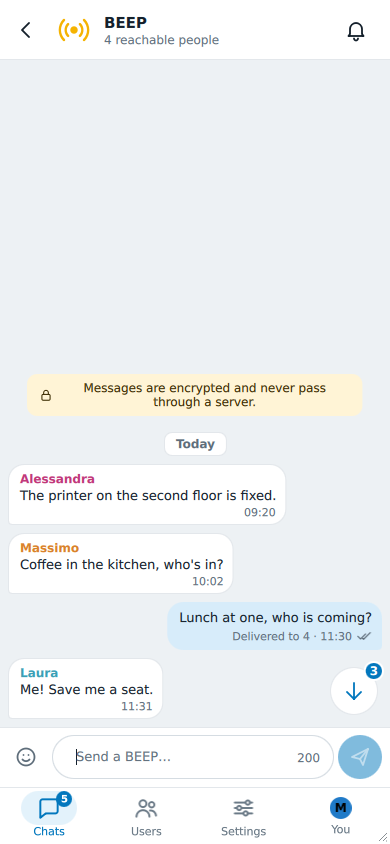
What a BEEP is
A BEEP is a short message to the people online at the moment you send it: "lunch at one, who is coming?", "the printer on the second floor is fixed", "the meeting moves to room B". BEEP is the first row of the Chats list, and under its name it says how many people a BEEP would reach now, for example 12 reachable people. The header of BEEP says the same.
A BEEP is not kept for later. Whoever is offline when you send it does not receive it when they come back, and whoever arrives afterwards does not see what was written before. BEEP is a message to the moment, the way a word said aloud in an office reaches whoever is in the room.
For a conversation that has to last -- a project, a team, a family -- create a group: a group keeps its members and its history, and a message waits for a member who is away.
Who receives a BEEP
A BEEP reaches everyone who, at the moment you send it:
- is online and connected directly to your BeeBEEP;
- takes part in BEEP (Join "BEEP" in Settings > Preferences, on unless they turned it off);
- is in sight, if you or they use circles.
Whether they are your contacts does not matter: BEEP is the same room for everybody on the network. The number under BEEP's name counts these people with the same rule, so you know before you write how many you are writing to. Someone you reach only through another user, with no direct connection between you, is not counted and does not receive your BEEPs.
When about 100 people are online in BEEP, it stops accepting new messages and says why -- Too many people are online for BEEP right now: write to the people you need in a group. -- until the number has come down again: you keep reading it, and you write to the people you need in a group.
It is public
BEEP is public: anyone online on the network can read what you write there, contacts or not. Each BEEP is encrypted on its way to every person, so nobody outside BeeBEEP can read it on the wire, but every person in BEEP is meant to. Do not write in BEEP what you would not say aloud in the room.
If BEEP is too noisy for you, mute it with the bell in its header, as any chat: you keep reading it, without notifications. To leave it altogether, turn off Join "BEEP" in Settings > Preferences: BEEP then disappears from your chats, and nothing is sent to you there.
Writing a BEEP
Open BEEP and write in the field that says Send a BEEP.... At the end of the field a number goes down as you type: how much room is left. It turns orange when you are close to the end, and red, below zero, when you have gone past it; Send then waits until the message is short enough.
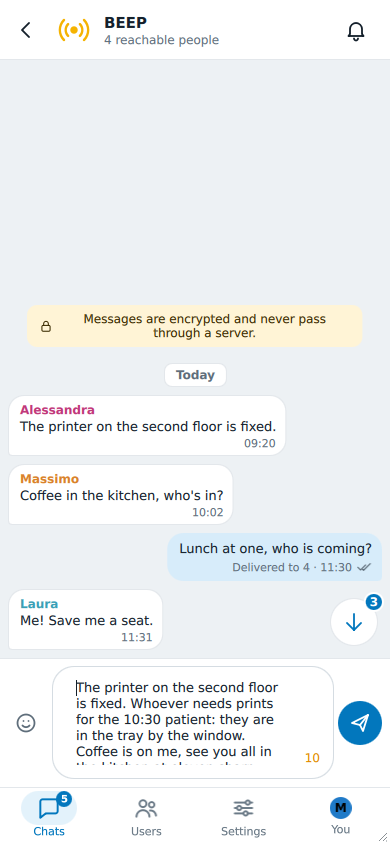
The number counts the space the message takes, not the letters: a plain letter takes one, an accented letter two, an emoji four or more. In practice a BEEP is about two hundred letters of ordinary text, fewer if it is full of emoji.
- Text only: files, pictures and voice messages go to a contact or a group.
- Quoting: you can answer a BEEP by quoting it, and the quotation takes none of your room. Everyone who has the quoted BEEP sees it above your answer; someone who arrived after it was written sees Message not available instead, since a BEEP reaches only the people online when it is sent.
- One at a time: after a BEEP, Send waits two seconds before the next one. Everyone else's BeeBEEP accepts BEEPs from one person at about that pace too -- a few in a row, then one every two seconds -- so a flood never reaches the room.
- Written, not forwarded: a message cannot be forwarded into BEEP. To share one there, copy its text and write it as a BEEP.
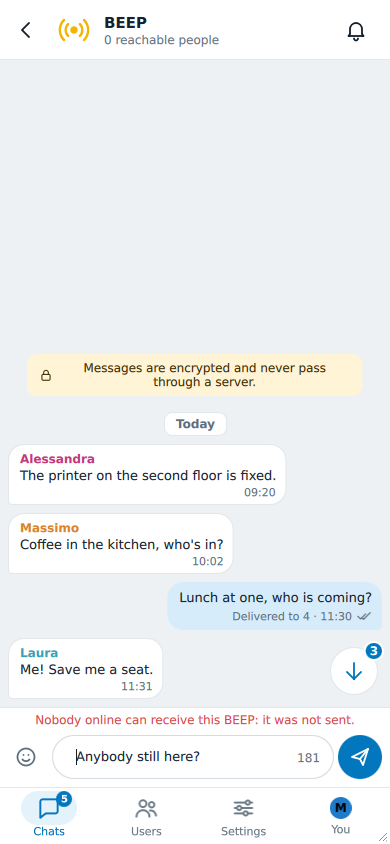
If nobody can receive it -- the header says 0 reachable people -- BeeBEEP does not send it and says Nobody online can receive this BEEP: it was not sent. Your text stays in the field for when someone arrives.
After you send it
Under your BEEP, before the time, BeeBEEP counts the people who have received it, for example Delivered to 12. The number grows as they receive it, in the first seconds after you send it.
Hold or right-click your BEEP and choose Info to see where it went: Delivered to 12 of 14 -- how many people it was delivered to out of how many it was sent to -- and each of them with the time it arrived. A person who left before it could reach them, or whose BeeBEEP did not answer within half a minute, shows Not delivered: BeeBEEP does not try again.
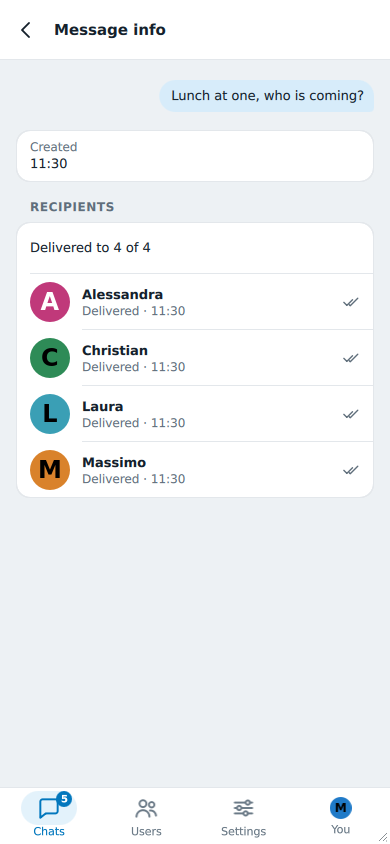
BEEP tells you that a message arrived, never who read it. In a room of many people, who has read an announcement says little, and every person reading it would send a message back across the network.
Reactions
You can react to a BEEP like any message. Your reaction goes to the author of that BEEP only, and only while the author is in BEEP: the two of you see it, nobody else does. The author sees every reaction on their message and in its Info.
Why BEEP works this way
BEEP comes from a simple question: when you write to everyone, who is everyone?
- You know before you send it. A message to everyone has to say how many people it reaches, and the rule that counts them is the same that sends it.
- Everyone is the same everyone for everybody. If each person wrote to their own contacts, two people would read two different conversations under the same name. BEEP reaches whoever is there, contacts or not, so the room is one.
- Now, not later, for everybody. Keeping a message for whoever just left, while whoever arrives a minute later never sees it, treats the two unequally. A BEEP goes to whoever is there, and that is all.
- Delivered, not read. Knowing that a message arrived is useful; knowing who read an announcement to a hundred people is not, and it costs a message per reader.
- Reactions to the author. The author wants them; everybody else would receive one more message for each reaction to each BEEP.
- Short. A BEEP is an announcement, not a letter. A conversation that goes on belongs in a group, where it is kept.
If you come from BeeBEEP 5
BEEP takes the place of Chat with Everyone. What changes for you:
- BeeBEEP 5 users are in BEEP. Your BEEPs reach the BeeBEEP 5 users online, in their Chat with Everyone, and what they write there arrives in BEEP. A long message from BeeBEEP 5 is shown whole; the limit applies only to what you write. A BeeBEEP 5 user can write six messages in a row there, then one a second, since their program cannot be asked to wait (BeeBEEP 6 and BeeBEEP 5).
- Your old history comes along. If you imported a BeeBEEP 5 installation, its saved Chat with Everyone is in BEEP as a card above the messages, Earlier messages from BeeBEEP 5.x, read only, and in the Archive at the top of your chats.
- No read status. BeeBEEP 5 did not show who had read a message in Chat with Everyone either; BEEP shows who received it.
- Short messages. A long text, a file or a picture goes to a contact or a group.